
Key takeaways
- Find the best digital bench multimeters for prototype testing, with clear guidance on digits, counts, logging, and the meters that suit a prototype bench.
Introduction
A prototype rarely behaves the way the schematic suggests. A regulator drifts as it warms up, a sleep current sits higher than the datasheet implies, and a sensor output wobbles by a few millivolts when a nearby switching supply kicks in. A handheld meter can confirm that a rail is present, but prototype testing usually needs more: steadier readings, finer resolution, and a way to watch a value over time while both hands stay on the board.
That is the job of a digital bench multimeter. It sits on the bench, plugged into mains power, with a large display that can be read from a normal working distance and front-panel terminals that stay connected while you probe, adjust, and take notes.
Prototype work is not one single task, so no single meter suits every bench. Checking 3.3 V logic levels needs different resolution than trimming a precision voltage reference or logging a battery discharge overnight. The right choice depends on how many digits you need, how fast the meter must read, and whether you plan to send readings to a computer. The four meters below cover the common cases: a compact first bench meter, a networked meter for automated checks, a long-serving 5.5-digit workhorse, and a precision instrument from a maker known for calibration-grade tools.
How to Choose a Digital Bench Multimeter for Prototype Testing
Digits and counts
A 4.5-digit meter shows up to 66,000 counts depending on the design, while a 5.5-digit meter shows up to 240,000 counts. More counts mean the display can show smaller changes, which matters when you watch a reference drift by a millivolt or compare two nearly identical resistors. For general prototype work, checking logic rails, continuity, and supply current, a 4.5-digit meter is usually enough. For trimming references or measuring small voltage drops across sense resistors, the extra digit of a 5.5-digit meter earns its place.
Accuracy
Digits and accuracy are not the same thing. A meter can display many digits while still carrying a wider accuracy figure, so check the basic DC voltage accuracy stated for each model. In this guide the figures run from 0.015 percent to 0.06 percent on the basic DC voltage range, with the tighter figures belonging to the 5.5-digit instruments. Accuracy matters most when a measurement feeds a decision: setting a reference, accepting a board, or recording a value for documentation.
Measurement speed
Reading speed is stated in readings per second. A meter that reads 65 times per second is fine for steady DC checks, while one that reads 123 or 150 times per second updates fast enough to follow a changing signal and to collect more points during a short test. Faster is not always better, because a fast meter can also show more noise on a sensitive range. Match the speed to the job: slow and settled for reference checks, faster for watching a signal move.
True RMS
All four meters in this guide measure true RMS AC voltage and current. True RMS matters whenever the signal is not a clean sine wave, which is common where switching supplies, PWM outputs, and chopped waveforms are present. An averaging meter can read low on such signals, so true RMS is a feature worth having.
Functions beyond voltage
A prototype bench meter should measure DC and AC voltage, DC and AC current, resistance in two-wire and four-wire modes, capacitance, frequency, continuity, and diode test as a minimum. Four-wire resistance removes lead resistance from the result, which matters when measuring low-value resistors and sense resistors.
Display and bench footprint
A bench meter is read from across the bench, often while you hold probes or a soldering iron, so the display matters. A dual display shows two quantities at once, such as DC voltage and the AC ripple on the same rail. A colour screen is easier to read at an angle, while a simpler monochrome display stays readable in bright light.
Computer connection and logging
Prototype testing often involves watching a value over minutes or hours, and that is where a computer connection earns its keep. USB is the most common link, with SCPI commands letting a short script collect readings into a file. LAN adds remote control and easier integration into an automated test setup, while RS232 suits benches that already use serial instruments. If you never plan to log data, a simpler meter without a network port will serve just as well.
Leads, terminals, and safety
Check the front-panel terminals before buying. A bench meter should accept standard banana plugs and shrouded test leads, with a separate high-current terminal for larger current checks. The maximum voltage and current ratings are printed near the terminals; never exceed them, and never measure current on a voltage range.
Top Picks
Rigol DM3058E 5.5-Digit Digital Bench Multimeter

The Rigol DM3058E has been a familiar sight on electronics benches for years, and it remains a strong choice for prototype testing because it covers the core job so completely. It is a true 5.5-digit instrument with 123,000 counts, so it shows small changes clearly when you trim a reference or compare two nearly identical voltage rails. It reads at up to 123 readings per second, measures true RMS AC voltage and current alongside DC voltage, DC current, resistance in two-wire and four-wire modes, capacitance, frequency, temperature, continuity, and diode test.
The dual display is one of the most useful features for prototype work. It can show a second quantity beside the main reading, such as frequency alongside AC voltage, so you get more information from a single connection. Pass and fail limit testing flags a reading that falls outside a band you set, which is handy when checking a batch of boards against the same limits.
For computer logging, the DM3058E connects over USB and RS232 with SCPI control, so a short script can collect readings into a file while a prototype runs. Its ranges reach 1000 V and 10 A, which covers the supplies and loads found on most prototype benches. The interface is a monochrome display with a button-driven menu rather than a touchscreen. There is no LAN port on this version, so automated setups that need a network connection should look at a meter that includes one.
Siglent SDM3045X 4.5-Digit Digital Bench Multimeter

The Siglent SDM3045X is the meter to consider when prototype testing includes automated checks. It is a 4.5-digit dual-display bench multimeter with 66,000 counts, a 4.3-inch colour TFT screen, and a reading speed of up to 150 readings per second. That speed, combined with USB device and host ports plus a LAN port, makes it the easiest meter in this guide to build into an automated test rig: a script can drive it over the network, collect readings, and log them without anyone sitting at the bench.
The measurement set covers DC and AC voltage and current, resistance, capacitance, frequency, continuity, diode test, and temperature, with true RMS AC measurement throughout. The dual display shows two readings from one signal at once, and the colour screen stays readable from across the bench.
Resolution is the trade-off here. A 4.5-digit meter shows less fine detail than the 5.5-digit instruments in this guide, so it is not the first choice for trimming a precision reference or measuring very small voltage drops. For the bulk of prototype work, checking rails, confirming current draw, verifying continuity, and logging a supply overnight, its resolution is ample, and the LAN connection plus the fast reading rate are worth more than an extra digit.
OWON XDM1041 Bench Multimeter
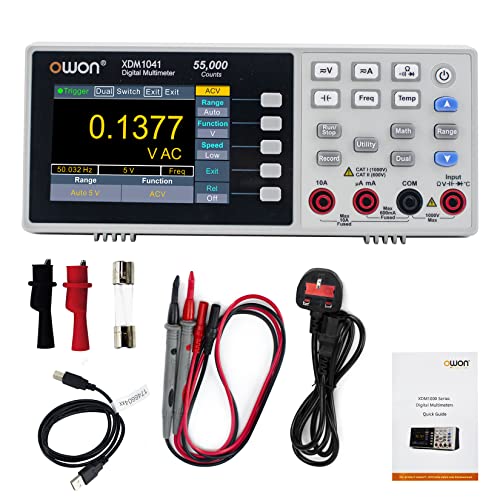
The OWON XDM1041 is the compact entry point in this guide, and it suits a crowded prototype bench where space is short. It is a 4.5-digit bench multimeter with 55,000 counts on a 3.5-inch colour TFT screen, a dual-line display, and DC voltage accuracy listed at up to 0.05 percent. It reads at up to 65 readings per second, which is fast enough for steady DC checks and for watching a supply rail settle after power-up.
The function set is broad for a compact meter. It measures AC and DC voltage and current, resistance, capacitance, diode test, continuity, and temperature with K-type and PT100 sensors, and AC is true RMS. Current ranges run from 500 microamps up to 10 A. A 1,000-point data log records measurements internally, and a USB port with SCPI support lets a computer collect readings for longer sessions.
Its AC bandwidth is limited to 1 kHz, which is worth noting if you measure higher-frequency AC signals, and its reading rate is slower than the other meters here. For a first bench meter, or as a second meter dedicated to a prototype under test, those limits are easy to live with.
Fluke 8808A 5.5-Digit Digital Bench Multimeter

The Fluke 8808A is the precision instrument in this guide, from a maker whose bench meters are widely used in manufacturing, development, and service work. It is a 5.5-digit bench multimeter with a basic DC voltage accuracy of 0.015 percent, and it measures volts, ohms, and amps plus frequency, with a resistance range reaching 100 megohms. That combination of resolution and accuracy makes it the meter to reach for when a measurement feeds a decision, such as setting a reference, accepting a board, or recording a value that will be quoted later.
The 8808A has a dual display that can show two readings at once, so you can watch a voltage and a related quantity without switching ranges or reconnecting leads. It also measures DC leakage current, which is useful when checking a supply or a capacitor for unwanted current paths during prototype testing. At 88 by 217 by 297 millimetres and 2.1 kilograms, it is a full-size bench instrument.
This is a more specialised meter than the others here, and its strength is precision rather than computer logging or a colour touchscreen. If your prototype work centres on careful measurement, calibration checks, and documented results, the 8808A is the most capable meter in this group. If your work centres on automated logging or a compact footprint, one of the other meters will fit better.
| Product | Key Feature | Best For |
|---|---|---|
| Rigol DM3058E | 5.5-digit, 123,000 counts, USB and RS232 | General prototype bench work with high resolution |
| Siglent SDM3045X | 4.5-digit, LAN and USB, 150 readings per second | Automated checks and unattended logging |
| OWON XDM1041 | 55,000 counts, compact colour display, USB SCPI | A first bench meter on a crowded bench |
| Fluke 8808A | 5.5-digit, 0.015 percent basic DC voltage accuracy | Precision measurement and documented results |
Buying Guide
Match the meter to the measurements you actually make
Start by listing the measurements your prototypes need. Checking 3.3 V and 5 V rails, confirming continuity, and measuring supply current are the daily tasks on most benches, and any meter in this guide handles them. Measuring a precision reference, a small voltage drop across a sense resistor, or the leakage of a capacitor needs finer resolution and tighter accuracy, which points toward a 5.5-digit meter. Logging a battery discharge or a thermal drift overnight needs a computer connection and a meter that can run unattended.
Decide how much resolution you need
A 4.5-digit meter is enough for the majority of prototype testing. A 5.5-digit meter adds a digit of resolution that matters when you compare two nearly identical values, trim a reference, or measure a small drop across a low-value resistor. If you are unsure, a 5.5-digit meter is the safer long-term purchase, because it covers both the coarse and the fine work.
Check the computer connection before you need it
Logging is easy to add later only if the meter already has the right port. USB with SCPI is the most flexible choice for a prototype bench, because a short script can collect readings into a file with very little setup. LAN is better for automated test rigs and for benches where the meter sits away from the computer. RS232 suits older equipment and simple serial logging.
Think about the bench, not just the meter
A bench meter shares space with a power supply, an oscilloscope, a soldering station, and the prototype itself. Measure the space before ordering, and check the depth of the meter as well as its width, since bench instruments are often deeper than they look in a photograph. A compact meter such as the OWON XDM1041 fits where a full-size instrument will not, while a full-size meter such as the Fluke 8808A needs a fixed position with room for leads at the front.
Confirm the exact model on the listing
Bench multimeters often come in closely related variants, and the differences matter. A model with a scanner card, a different interface set, or a different digit count can share a similar name with the base model. Before ordering, confirm the model number on the Amazon listing page, check the listed functions against the maker data sheet, and confirm what is included in the box.
Plan for calibration and care
A bench meter holds its accuracy only if it is treated well. Keep it away from heat and dust, avoid dropping it, and do not exceed the voltage and current ratings printed near the terminals. A meter that is used for documented measurements should be calibrated on a schedule set by your work, and the calibration record kept with the instrument.
Frequently Asked Questions
Do I need a 5.5-digit meter for prototype testing?
Not always. A 4.5-digit meter covers the daily work of checking rails, continuity, and current draw on most prototypes. A 5.5-digit meter becomes worth having when you trim precision references, measure small voltage drops across sense resistors, compare nearly identical values, or record measurements that feed into documentation.
What does true RMS mean, and do I need it?
True RMS means the meter measures the effective value of an AC signal regardless of its waveform shape. An averaging meter assumes a clean sine wave and can read low on the chopped or pulsed waveforms that switching supplies and PWM outputs produce. Prototype benches are full of such signals, so true RMS is worth having, and every meter in this guide includes it.
Can a bench multimeter log data to a computer?
Yes, if it has a suitable interface. The meters in this guide connect over USB, and two of them add LAN or RS232. With SCPI commands, a short script can collect readings into a file while a prototype runs, which is useful for battery discharge tests, thermal drift checks, and overnight soak tests. Check that the meter you choose has the interface your computer setup needs before ordering.
Is a bench multimeter better than a handheld meter for prototype work?
For bench work, usually yes. A bench meter has a larger display that can be read from a distance, a dual display that shows two quantities at once, finer resolution, and a computer connection for logging. A handheld meter is better for field work, for checking wiring away from the bench, and for quick spot checks.
Conclusion
The best digital bench multimeter for prototype testing is the one that matches the measurements you make most often, with enough resolution and accuracy for the decisions those measurements feed. The Rigol DM3058E is the most balanced choice for a general prototype bench, with 5.5-digit resolution and USB logging in a long-serving design. The Siglent SDM3045X is the pick for automated checks and unattended logging, thanks to its LAN connection and fast reading rate. The OWON XDM1041 is the compact first bench meter, giving a small bench a real bench instrument with a clear colour display and computer logging. The Fluke 8808A is the precision choice, for work where accuracy and documented results come first.
Whichever meter you choose, confirm the exact model on the listing, check the included leads and interfaces against your bench, and give the instrument a fixed position where its display can be read while you work.
Disclosure: As an Amazon Associate, we earn from qualifying purchases.
FAQ
Do I need a 5.5-digit meter for prototype testing?
What does true RMS mean, and do I need it?
Can a bench multimeter log data to a computer?
Is a bench multimeter better than a handheld meter for prototype work?
More from Amazon
Programs that pair well with the guide above. Offers and eligibility are set by Amazon and may change.
Free shipping on eligible items, Prime Video and more. Eligible new members can start with a free trial.
Start a Prime free trialAudiobooks and podcasts to listen to on the go. Eligible new members can start with a free trial.
Try Audible freeAd-free music streaming. Eligible new subscribers can start with a free trial.
Try Music Unlimited freeA free business account with business pricing and bulk-buying tools for work, shop or home office.
Create a business accountAs an Amazon Associate we earn from qualifying purchases.






Write Your Review
No reviews yet. Be the first to share your experience!