
Key takeaways
- Compare 4 USB oscilloscopes for prototype testing by bandwidth, sample rate, isolation and software, from budget Hantek to PicoScope and Digilent picks.
Choosing a USB oscilloscope for a prototype bench is really a decision about limits you will live with every day. Bandwidth and sample rate decide which signals you can trust, memory decides whether a brief glitch stays visible, and grounding decides whether connecting to a powered board is routine or risky. A low headline bandwidth can still be fine for audio, sensors and slow control signals, while a faster board with serial decoding needs more headroom than the clock rate alone suggests.
This guide is for makers, students and engineers building and debugging prototypes on a laptop or desktop, who want a PC-based scope with no built-in screen. The four picks below were chosen from their Amazon titles and listed specifications, covering a simple budget scope, an isolated model, a software-focused model and a higher-resolution multi-function instrument, so you can match the tool to the signals you actually debug.
Quick Picks
As an Amazon Associate we earn from qualifying purchases
| Product | Best for | Key spec from title |
|---|---|---|
| Hantek 6022BE | Lowest-cost basic probing | 2 channel, 20 MHz, 48 MSa/s |
| OWON VDS1022I | Safer connections to powered boards | 25 MHz with USB isolation |
| Pico Technology PicoScope 2204A | Polished PC software experience | 2 channel, 10 MHz, USB powered |
| Digilent Analog Discovery 3 | Higher resolution plus extra instruments | 125 MS/s USB oscilloscope |
How to Choose
Bandwidth and sample rate for your signals
Start from the fastest signal on your prototype, not from the microcontroller clock printed on the box. A board switching at a few megahertz, with fast edges from modern logic, can look rounded or misleading on a scope whose bandwidth is only just above the fundamental frequency. For slow sensor outputs, motor control pulses and audio work, 10 to 25 MHz can be enough. For faster digital edges, look for sample rate well above the bandwidth figure, because a scope such as the 100 MS/s OWON or PicoScope models captures edge timing more usefully than a similar-bandwidth model sampling at under 50 MS/s.
Channels, memory and triggering
Two channels are the practical minimum for prototype work, because most debugging compares an input with an output, a clock with data, or a gate drive with the resulting waveform. Memory depth matters as much as channel count: a short capture memory can force a trade-off between seeing a long event and keeping fine time detail. Check what the listing states, for example the PicoScope 2204A lists 8 kS capture memory, while the OWON lists a 5K record length. Also confirm the trigger types you need, especially edge triggering for routine work and more flexible options if you chase intermittent faults.
Isolation, grounding and input range
A standard USB oscilloscope usually shares ground with the computer, which shares ground with mains earth through the power supply. That is fine for battery-powered and properly isolated low-voltage prototypes, but it can create a short or damage equipment if you clip a ground lead onto a live or floating node. An isolated model such as the OWON VDS1022I, whose title highlights USB isolation, reduces that risk and the noise that ground loops add. Whatever model you choose, check the listed input range and always use the attenuated probe setting before probing anything beyond low-voltage logic.
Software, decoding and extra instruments
With a PC-based scope, the software is half the product. It controls triggering, measurements, saving waveforms and, on some models, serial decoding that helps you relate an analog waveform to I2C, SPI or UART traffic on the same prototype. Check operating system support before buying, because a scope that only works on one system is a poor fit for a mixed laptop setup. Extra instruments can also change value: the Digilent entry below is transparently a multi-function USB test instrument whose oscilloscope sits alongside a waveform generator, logic analyzer and variable power supply, rather than a scope-only box.
The 4 Best Options
Hantek 6022BE

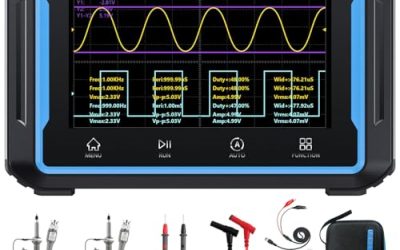
The Hantek 6022BE is the straightforward starting point for prototype testing on a tight budget. Its listed 20 MHz bandwidth and 48 MSa/s sample rate suit audio circuits, power supply ripple checks, sensor outputs and slower microcontroller signals, where the main need is simply to see whether a waveform is present, clean and roughly the right shape. It is a PC-based design with two channels, so you can compare a signal before and after a stage. The listing includes two probes and a USB cable, which keeps the starter kit simple for a first bench.
Specs
- Brand: Hantek
- Model: 6022BE
- Channels: 2
- Bandwidth: 20 MHz
- Sample rate: 48 MSa/s
- Interface: PC-based USB
- Included: 2 probes and USB cable
Best for: First-scope buyers debugging low-speed prototypes and power rails.
Watch out for: The 48 MSa/s rate and lack of listed USB isolation limit fast-edge and higher-risk work.
ASIN: B0728HBNDV
OWON VDS1022I

The OWON VDS1022I adds the feature many prototype benches actually need most: USB isolation, called out in its Amazon title. Isolation helps protect the computer and reduces ground-loop problems when a prototype is powered from another supply. Its listed 25 MHz bandwidth and 100 MS/s sample rate give it more timing headroom than the Hantek above, making it a sensible step up for switching regulators, motor drivers and faster logic signals. The slim, bus-powered design also suits a crowded bench or a laptop kit, and the listed 5K record length is adequate for short, repeatable captures.
Specs
- Brand: OWON
- Model: VDS1022I, item model number 01VDS1022I
- Channels: 2
- Bandwidth: 25 MHz
- Sample rate: 100 MS/s
- Interface: USB with isolation, bus powered
- Record length: 5K
- Dimensions: 6.69 x 4.72 x 0.71 inches
Best for: Powered prototypes where isolation and a compact footprint matter.
Watch out for: The short 5K record length limits long single captures at high detail.
ASIN: B07PRT5WMJ
Pico Technology PicoScope 2204A

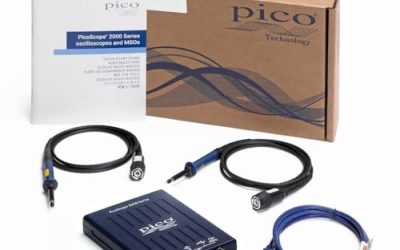
The PicoScope 2204A trades headline bandwidth for a mature PC-scope package. Its listed bandwidth is 10 MHz, the lowest here, yet its 100 MS/s sample rate and the long-established PicoScope software approach make it appealing if your prototypes are mostly low-speed analog, audio, sensors and slow digital control. Two channels let you compare related signals, and the kit listing includes two switchable passive probes, a USB cable and a quick start guide, so there is little else to assemble. Choose it for usability and measurement workflow, not for chasing the fastest edges on a modern digital board.
Specs
- Brand: Pico Technology
- Model: PicoScope 2204A
- Channels: 2
- Bandwidth: 10 MHz
- Sample rate: 100 MS/s
- Capture memory: 8 kS
- Power: USB powered
- Included: Two x1/x10 passive probes, USB 2.0 cable and Quick Start Guide
Best for: Low-speed prototypes where software workflow matters more than bandwidth.
Watch out for: The 10 MHz bandwidth is the first limit you will hit on faster digital designs.
ASIN: B00GZMRZ3M
Digilent Analog Discovery 3

The Analog Discovery 3 should be understood clearly: it is a multi-function USB test instrument, and the oscilloscope is one of several instruments it provides in WaveForms software, alongside a waveform generator, logic analyzer and variable power supply. That breadth is exactly why it suits prototype testing, because one box can stimulate a circuit and measure the response. Its oscilloscope listing is also the strongest here on paper, with two differential channels, 14-bit resolution and up to 125 MS/s per channel. It is the pick for mixed-signal prototypes where stimulus, digital lines and analog measurement belong in one session.
Specs
- Brand: Digilent
- Model: Analog Discovery 3, item model number 410-415
- Oscilloscope channels: Two differential channels
- Resolution: 14-bit
- Sample rate: Up to 125 MS/s per channel
- Input range: +/-25 V
- Bandwidth: 30+ MHz with BNC Adapter
- Digital channels: 16 digital I/O channels
- Included: USB-C to USB-C programming cable and 2×15 flywire signal cable assembly
Best for: Mixed-signal prototypes needing stimulus, logic and scope in one USB instrument.
Watch out for: Reaching the stated bandwidth requires the BNC Adapter, and flywire connections differ from standard probe leads.
ASIN: B0C4L59R83
Which One Fits Your Situation
You are building your first low-speed prototype bench
Start with the Hantek 6022BE if your boards are audio, sensor or basic microcontroller projects and you mainly need to confirm waveforms, ripple and timing at modest speeds. It covers the essential two-channel PC-scope role with the probes included. Move up only when your signals get faster or your power setup makes isolation important, rather than paying at the start for resolution or extra instruments you may not use yet.
Your prototype is powered and grounding worries you
Choose the OWON VDS1022I when the board under test is mains-adjacent through its supply, driven by a motor controller, or connected to other bench equipment at the same time. Its USB isolation is the deciding feature, and its 25 MHz bandwidth with 100 MS/s sampling is enough for many power and control prototypes. It is also the neatest fit if bench space is tight and you want the scope bus powered from the computer.
You debug mixed-signal boards and need stimulus too
Pick the Digilent Analog Discovery 3 if one session involves generating a test waveform, watching analog nodes and checking digital lines together. Its 14-bit oscilloscope inputs, 16 digital channels and built-in generator and supplies remove the need to juggle separate instruments for early prototype bring-up. Accept the flywire style of working, or budget attention for the BNC adapter path if you want conventional probing and the full listed bandwidth.
You value an easy PC workflow for slow signals
Take the PicoScope 2204A if your prototypes are deliberately low speed and you spend more time measuring, saving and comparing waveforms than chasing fast edges. Its bandwidth is modest, so be honest about that ceiling, but the included probes, USB power and established software focus suit teaching benches, audio work and sensor development. If your next project moves into faster digital clocks, plan to replace rather than stretch this model.
Common Mistakes
- Buying on bandwidth alone and ignoring sample rate, memory depth and triggering, which decide whether a real fault can be captured.
- Clipping a standard USB scope ground lead onto a non-ground node on a powered prototype, creating a short through the computer.
- Assuming a 10x probe setting is optional, then exceeding the listed input range on a power rail or switching node.
- Choosing a multi-function instrument without noticing its connections, for example flywires instead of conventional BNC probe leads.
- Forgetting to check software support for your operating system before ordering a PC-based scope with no screen of its own.
Frequently Asked Questions
Can a USB oscilloscope replace a bench oscilloscope for prototypes?
For many low-voltage prototypes, yes, provided the bandwidth, sample rate and input limits match the signals involved. A USB model uses the computer for its display and controls, which saves bench space and simplifies saving waveforms. It is less suitable where you need high bandwidth, high-voltage probing, complete isolation on every channel or controls that work without a computer present.
How much bandwidth do I need for microcontroller prototypes?
Match bandwidth to edge speed and harmonics you need to see, not only to clock frequency. Slow GPIO, I2C, audio and sensor work can be handled by the 10 to 25 MHz models in this guide. Faster SPI, switching power stages and modern logic edges benefit from more headroom, so a model adequate for the clock alone may still round the edges you are trying to diagnose.
Why does USB isolation matter on a prototype bench?
Isolation breaks the direct ground path between the prototype and the computer. That reduces ground-loop noise and lowers the risk of a short when the circuit under test is powered from another source or sits at a different ground potential. It does not make probing careless work safe, and input voltage limits still apply, but an isolated model such as the OWON gives a wider margin for powered-board testing.
Is a multi-function instrument better than a scope-only USB model?
It depends on the stage of prototyping. A scope-only model is simpler if you already own a signal generator, logic analyzer and bench supplies. A multi-function instrument such as the Analog Discovery 3 is more convenient during bring-up, because stimulus and measurement live in one software session. The trade-off is connection style and shared attention: one box does several jobs, rather than each job having dedicated hardware controls.
FAQ
Can a USB oscilloscope replace a bench oscilloscope for prototypes?
How much bandwidth do I need for microcontroller prototypes?
Why does USB isolation matter on a prototype bench?
Is a multi-function instrument better than a scope-only USB model?
More from Amazon
Programs that pair well with the guide above. Offers and eligibility are set by Amazon and may change.
Free shipping on eligible items, Prime Video and more. Eligible new members can start with a free trial.
Start a Prime free trialAudiobooks and podcasts to listen to on the go. Eligible new members can start with a free trial.
Try Audible freeAd-free music streaming. Eligible new subscribers can start with a free trial.
Try Music Unlimited freeA free business account with business pricing and bulk-buying tools for work, shop or home office.
Create a business accountAs an Amazon Associate we earn from qualifying purchases.






Write Your Review
No reviews yet. Be the first to share your experience!