
Key takeaways
- Compare five TENS units by channels, modes, intensity range, battery type and pads included, from a budget dual-channel model to a wireless system.
A TENS unit sends mild electrical pulses through electrode pads on the skin, and the makers describe the sensation as a way to ease sore, aching muscles and joints without medication. The five units below all do that same basic job, but they split on the details that decide how one fits your routine: wired or wireless, preset programs or manual pulse settings, disposable cells or a rechargeable battery, and one treatment area at a time or two.
Four of these picks are wired handhelds with lead wires and snap-on pads, while the iReliev system replaces the wires with two small pods. Mode counts run from 5 on the TENS 7000 to 24 on the Belifu, session timers run from a fixed 15 minutes on the OMRON to a full hour on the rechargeable models, and every figure below comes from the maker’s own listing or manual.
As an Amazon Associate, we earn from qualifying purchases.
Quick answer
For most people, the TENS 7000 is the unit to buy first: dual channels, five modes, and manual pulse width and pulse rate dials no preset-only rival here matches. The Belifu packs 24 modes into the budget pick, the MEDVICE is the compact rechargeable, the OMRON is the simplest brand-name option, and the iReliev goes fully wireless at the premium end.
TENS 7000 Digital TENS Unit

Specs
- : Dual channel, four electrode pads; 5 modes (Burst, Normal, Modulation, Strength Duration 1, Strength Duration 2); pulse rate adjustable 2 to 150 Hz; pulse width adjustable 50 to 300 microseconds; amplitude adjustable per channel; timer 5 to 60 minutes or continuous; runs on one 9V battery, included; kit includes lead wires and a carrying case; made by Roscoe Medical.
The TENS 7000 is the pick for anyone who wants to shape the pulse itself rather than pick from a menu. Its pulse width and pulse rate adjust independently, which is the control layout clinics use, and the two channels run separate intensity settings so a knee and a shoulder can be treated in the same session at different strengths. Five modes cover the standard patterns, including two strength-duration settings aimed at harder-to-reach discomfort.
The trade-offs are plain. Power comes from a disposable 9V cell rather than a rechargeable pack, the screen and buttons are basic next to the backlit displays below, and the wired pads tether you to wherever you sit for the session. As the mid-range pick, it suits buyers who value adjustment depth over convenience features and plan to use the unit at home on a regular schedule.
Belifu Dual Channel TENS EMS Unit

Specs
- : Dual channel with independent A and B control; 24 preprogrammed TENS and EMS modes; 20 intensity levels; rechargeable battery, USB charging; adjustable timer up to 60 minutes; 10 electrode pads included; pads holder, drawstring storage bag and cable ties in the box; item weight 10.54 ounces per the listing; model SM9126.
The Belifu is the mode collector of the group. Twenty-four programs split between TENS patterns for pain and EMS patterns for muscle work, and the two channels accept different modes and intensities at the same time, so one channel can run a gentle setting on a wrist while the other works a back at full strength. Twenty intensity steps keep the jumps between levels small.
It is also the lightest full kit here and the budget pick of the five, with the pads, holder and storage bag all in the box. The housing and screen feel plainer than the brand-name units, and the mode list takes a few sessions to learn. For a first TENS unit, or a second one for a gym bag, it covers the widest ground in this roundup.
MEDVICE Rechargeable TENS Unit, MV950

Specs
- : Model MV950, second generation; dual channel, 2 outputs; 16 preprogrammed modes; 20 intensity levels; rechargeable lithium battery with USB cable and wall adapter included; timer adjustable 10 to 60 minutes with auto shut-off; backlit LCD screen; 8 pads included (2 large, 4 medium, 2 small); carry bag and pad collection board in the box; FDA cleared per the maker.
The MEDVICE trims the formula down to a pocketable rectangle with a big animated display. Sixteen modes and twenty intensity levels sit behind a simple button layout, the backlit screen reads clearly in a dim room, and the three pad sizes in the box let you match the pad to the body part instead of forcing one square onto everything from a forearm to a lower back.
Sessions time out anywhere from 10 to 60 minutes, and the rechargeable cell removes the battery errands the TENS 7000 and OMRON both create. The mode count is lower than the Belifu’s and there is no wireless freedom here, so this mid-range pick is for buyers who want a tidy, self-contained kit for home and travel rather than the longest feature list.
OMRON Max Power Relief, PM500
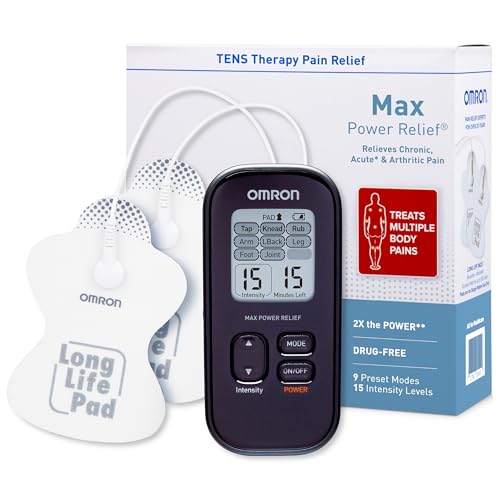
Specs
- : Model PM500; 6 body-area modes (shoulder, lower back, arm, foot, leg, joint) plus 3 massage-like modes (tap, knead, rub); 15 intensity levels; 15 minute sessions with auto shut-off; 2 Long Life Pads included, rated by the maker for up to 150 uses; runs on 2 AAA batteries, included; device weight 0.22 pounds per the maker’s specification table; pad holder included.
OMRON organizes its programs by body part instead of by waveform, which makes the PM500 the easiest unit here to hand to a first-time user: pick the shoulder program, set one of fifteen intensity levels, and the session runs its 15 minutes and stops. The maker rates this model at twice the output of its smaller Pocket Pain Pro, aimed at deep, recurring aches in the back, knees and shoulders.
The fixed 15 minute session is the main limit, since the rechargeable rivals run up to an hour, and the AAA cells are a recurring errand. The Long Life Pads rated for up to 150 uses soften that, because pad replacement is the other running errand with these devices. As the premium brand-name pick, it suits buyers who trust an established medical device maker and want the fewest decisions per session.
iReliev Wireless TENS + EMS Therapeutic Wearable System
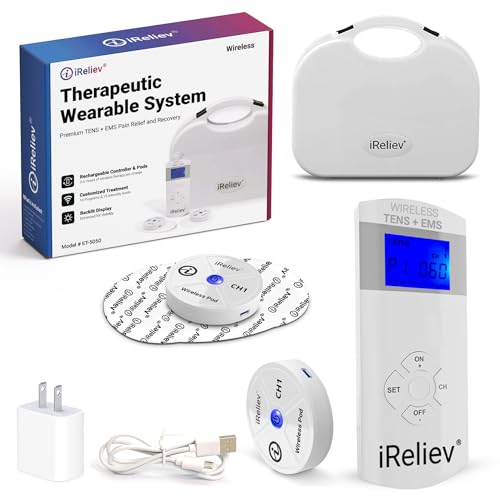
Specs
- : Handheld remote with 2 wireless receiver pods; 14 preset programs (8 TENS programs and 6 EMS programs); treatment time set in 5 minute steps up to 60 minutes per session; rechargeable lithium batteries in remote and pods; backlit display; pods run independently or in sync; electrode pads snap directly onto the pods, no lead wires.
The iReliev removes the part of TENS that annoys people most: the wires. Each pod snaps onto its pad and sticks to the skin, the remote drives both pods from across the room, and the pods hide under clothing, so a session can run at a desk or on a walk instead of tying you to a chair. Eight TENS programs handle pain relief while six EMS programs cover muscle conditioning and recovery work.
That freedom defines the premium tier here. The system carries the most parts to keep charged, the pods are small enough to misplace, and replacement pads are a proprietary fit. For active users who know they would skip sessions if setup took more than a minute, it is the one unit in this group built around wearing rather than sitting.
How to choose
Channels decide how much of you gets treated at once. A dual-channel unit runs four pads across two areas with separate intensity for each, which suits paired problems like both knees or a back plus a shoulder. Single-area users can save by going simpler, though every pick here is dual output in some form because that flexibility is what home users ask for most.
Modes come in two philosophies. Preset programs, from the MEDVICE’s 16 to the Belifu’s 24, package a pulse pattern behind one button and suit most people. Manual pulse width and rate controls, found here only on the TENS 7000, let you tune the signal itself, which experienced users and clinic patients often prefer. Neither approach is stronger by default; they differ in how much adjusting you want to do.
Power source shapes the routine. Rechargeable units (Belifu, MEDVICE, iReliev) plug in by USB and ask nothing between charges, while the 9V cell in the TENS 7000 and the AAA pair in the OMRON mean keeping spares in a drawer. Pad supply matters too: gel pads lose grip over time, so check what sizes a kit includes and whether long-life pads fit your habits.
Finally, read the maker’s safety page before the feature list. Every brand here publishes the same core warnings: no use with a pacemaker or implanted device, no use during pregnancy, and no pads over the front of the neck or across the chest. If any of those apply, a TENS unit is the wrong purchase regardless of mode count.
Who should skip
Skip this category entirely if you use a pacemaker, defibrillator or other implanted electronic device, or if you are pregnant: the makers of all five units print those warnings, and no feature in this roundup changes them. Anyone with undiagnosed pain should also skip the purchase and get the cause checked first, since these devices address symptoms rather than sources.
Skip TENS if what you actually want is heat or deep pressure. A heating pad warms tissue and a percussion massager kneads it; a TENS unit does neither, and its tingling pulse disappoints buyers expecting a massage. Also skip the wireless premium if you know small parts wander in your home, because a lost pod disables half the iReliev system. And if you only ever treat one small area, the dual-channel kits here give you hardware you will never switch on.
FAQ
What is the difference between TENS and EMS?
TENS targets the nerves to ease the feeling of pain, while EMS makes muscles contract and relax for conditioning and recovery. Several units here, including the Belifu and the iReliev, combine both in one device with separate program groups, so the box you buy for a sore back can also run a recovery session after exercise.
How long should one TENS session last?
Session length follows the timer the maker builds in. The OMRON runs a fixed 15 minutes, the MEDVICE and Belifu adjust up to 60 minutes, and the TENS 7000 adds a continuous setting. The makers advise beginning at a low intensity, running one session, and rating your pain again before deciding on another.
How often do electrode pads need replacing?
Gel pads lose adhesion with use, skin oil and storage, and a pad that will not stay flat delivers uneven pulses. Standard pads in these kits are consumables with no fixed count published, while OMRON rates its Long Life Pads for up to 150 uses. Wiping skin before application and returning pads to their holder between sessions stretches any set further.
Can one dual-channel unit treat two areas at once?
Yes, that is the point of the design. Independent channels, such as the Belifu’s A and B outputs or the TENS 7000’s per-channel amplitude, run two pad pairs at different modes or intensities in the same session. The iReliev takes the idea further, since its two pods can run in sync or on separate programs.
Final verdict
The TENS 7000 remains the reference point for home TENS: manual pulse control, honest specs and a complete wired kit. The Belifu answers with 24 modes and the lightest budget package, the MEDVICE with a tidy rechargeable design, and the OMRON with body-part programs and long-life pads. The iReliev closes the group by removing the wires altogether. Match the channel count, power source and pad style to your routine and any of the five will do the job its maker describes.
Product and ASIN Reference
| Product name | ASIN |
|---|---|
| TENS 7000 Digital TENS Unit | B00NCRE4GO |
| Belifu Dual Channel TENS EMS Unit | B09KNJPCC3 |
| MEDVICE Rechargeable TENS Unit MV950 | B07D5ML4HM |
| OMRON Max Power Relief PM500 | B00SVPNZXU |
| iReliev Wireless TENS + EMS System | B073DGQ4KD |
FAQ
What is the difference between TENS and EMS?
How long should one TENS session last?
How often do electrode pads need replacing?
Can one dual-channel unit treat two areas at once?
More from Amazon
Programs that pair well with the guide above. Offers and eligibility are set by Amazon and may change.
Free shipping on eligible items, Prime Video and more. Eligible new members can start with a free trial.
Start a Prime free trialAudiobooks and podcasts to listen to on the go. Eligible new members can start with a free trial.
Try Audible freeAd-free music streaming. Eligible new subscribers can start with a free trial.
Try Music Unlimited freeA free business account with business pricing and bulk-buying tools for work, shop or home office.
Create a business accountAs an Amazon Associate we earn from qualifying purchases.





Write Your Review
No reviews yet. Be the first to share your experience!