
Key takeaways
- Compare the best handheld digital oscilloscopes for small laboratory spaces, with bandwidth, battery, display and multimeter tips to save bench space.
A small laboratory rarely suffers from a lack of ideas. It suffers from a lack of surface. Benches fill quickly with a power supply, a soldering station, component trays, a laptop, and the board that is actually being worked on. A full-size benchtop oscilloscope, however capable, claims a permanent footprint, needs a mains outlet nearby, and often forces everything else to move around it. That is why the best handheld digital oscilloscopes for small laboratory spaces have become a practical alternative rather than a compromise purchase.
A handheld digital oscilloscope puts the acquisition system, display, controls, and battery in one unit that can be picked up, used at the point of measurement, and then stored in a drawer or carrying case. Many current models also combine a digital multimeter and, in some cases, a signal generator in the same housing. For a compact lab, that consolidation matters as much as raw performance: one handheld instrument can replace two or three separate boxes for everyday checks such as verifying a clock, looking for ripple, comparing an input and an output, or confirming that a sensor signal is present and clean.
As an Amazon Associate we earn from qualifying purchases
Why Handheld Scopes Suit Small Laboratories
The obvious advantage is size, but the working advantages go further. Battery operation means the scope can be used away from a crowded power strip and can be moved to a shelf, a repair corner, or another room without unplugging and re-routing cables. Floating a measurement, working inside an equipment rack, or checking a board while it is still mounted in a project enclosure is also easier when the instrument is not tethered to the bench.
There are honest trade-offs. Handheld displays are smaller than benchtop displays, record lengths tend to be much shorter, and controls are more compact. Those limits are manageable when they are understood in advance and matched to the work, which is what the buying criteria below are for.
How to Choose a Handheld Oscilloscope for a Small Lab
Bandwidth
Bandwidth describes the highest frequency the scope can display with reasonable fidelity. As a working rule, choose bandwidth comfortably above the fastest signal you expect to examine, especially for square waves and digital edges, where the important content extends well beyond the fundamental frequency. For audio, power-supply work, and slow sensor signals, modest bandwidth is often sufficient. For microcontroller clocks, PWM edges, and faster serial signals, a higher bandwidth model gives a more truthful picture of rise times and ringing. Buying far more bandwidth than your signals need adds cost without adding useful information, so match the figure to your typical circuits rather than to a worst case you may never meet.
Sample Rate
Sample rate, expressed in mega-samples per second, determines how densely the scope captures a waveform. A higher real-time sample rate preserves fast, one-off events better and reduces the risk of aliasing, where a fast signal is displayed as a misleading slower one. Note that on two-channel handheld scopes the headline rate is often the single-channel rate, with a lower rate available per channel when both channels run together. Check both figures if you regularly compare two signals at speed.
Channels
Two channels are the practical standard for this class, and for good reason. A second channel lets you view an input and an output at the same time, compare a trigger signal with a data line, or check timing between two points in a circuit. Single-channel pocket scopes exist and are smaller still, but for laboratory troubleshooting the ability to make a direct comparison is usually worth the slightly larger housing.
Battery Life and Charging
Battery operation is central to the handheld concept, so look at both capacity and charging method. USB Type-C charging is especially convenient in a small lab because the same chargers and cables used for other modern equipment can top the scope up, reducing cable clutter. Consider how long a typical session lasts for you, whether the scope will be used away from the bench, and whether auto power-off settings can stretch a charge across a working day.
Display
Display size and resolution shape how usable a handheld scope feels in practice. A larger screen makes it easier to read two traces plus automatic measurements without squinting, and a touch screen can speed up menu navigation. A smaller screen keeps the unit compact and is perfectly workable for quick checks. In a small lab that may also be dim or brightly lit, adjustable brightness and a clear, high-contrast display are worth more than headline size alone.
Multimeter Functions
A built-in multimeter is one of the strongest space-saving arguments for these instruments. Useful meter functions include AC and DC voltage, current, resistance, capacitance, diode test, and continuity. The count figure, such as 19,999 counts, indicates display resolution on the meter side. If the scope will also serve as your everyday meter, check that its voltage and current ranges cover your work and pay attention to safety ratings before measuring higher-energy circuits. A combined instrument is convenient, but convenience never overrides the need to respect the ratings printed for the device and its leads.
Storage Footprint and Handling
Finally, judge the instrument as a physical object in your specific space. Look at its dimensions and weight, whether it has a stand for angled viewing on the bench, whether the probes and leads store neatly in an included case, and whether the controls can be operated with one hand. A scope that is pleasant to hold, quick to wake, and easy to put away will be used more often than a technically stronger unit that is awkward to deploy for a two-minute check.
The Handheld Oscilloscopes in This Guide
FNIRSI 2C53P Handheld Tablet Oscilloscope

The FNIRSI 2C53P is built around readability, which is often the first thing sacrificed in a handheld instrument. Its listing describes a 4.3-inch IPS touch screen with 480 by 272 resolution, noticeably larger than the small displays fitted to many pocket scopes. For a small laboratory, that matters when two traces and on-screen measurements need to be read at a glance without connecting an external monitor and giving up still more bench space.
As an oscilloscope, the 2C53P provides two channels with 50 MHz bandwidth and a 250 MS/s sampling rate, according to its Amazon listing. That combination is aimed at general electronics work: microcontroller signals, PWM outputs, audio circuits, power-supply ripple, and sensor outputs all sit comfortably within that envelope. The touch interface is the other distinguishing feature. Instead of stepping through every setting with a small set of buttons, the operator can work directly on the screen, which can make changing timebase, triggering, and measurement settings feel closer to using a modern bench instrument.
Power comes from a built-in 4000 mAh lithium battery, with the listing stating a battery life of about four hours and charging through a Type-C interface. That is enough for a focused troubleshooting session or a series of shorter checks across a day, and Type-C charging keeps the cable situation simple. The package dimensions given in the listing are 9.02 by 5.43 by 2.83 inches, with a weight of 1.61 pounds for the packaged item, so the kit is sized for a drawer or a carrying case rather than permanent bench residence.
Choose the 2C53P if display clarity and touch operation are your priorities and your signals sit within a 50 MHz bandwidth. It is the most screen-focused option in this guide, and for users who find small scope displays tiring, that alone can be the deciding factor. Confirm the current bundle contents on the listing before ordering, because probe counts and included accessories can vary between packages.
Hantek 2D72 Handheld Oscilloscope

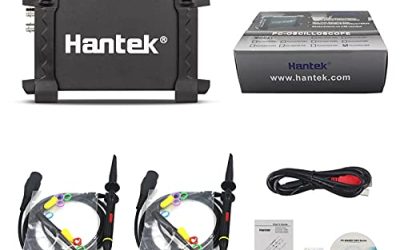
The Hantek 2D72 takes the opposite approach to the touch-screen model above: a compact, button-driven handheld with a higher bandwidth figure and a three-in-one layout that has been on the market for several years. Its Amazon listing describes a two-channel oscilloscope with 70 MHz bandwidth and a sampling rate of 250 MSa/s in single-channel use and 125 MSa/s in dual-channel use. That makes it the highest-bandwidth option in this guide, and the natural candidate here for faster digital edges and higher-frequency analogue work.
The second function is a digital multimeter covering voltage, current, resistance, capacitance, diode, and continuity measurements, as described in listing material for this model. The third function, present on the 2D72 variant, is a waveform generator. Listing information describes sine output up to 25 MHz, with square, triangular, and trapezoidal waveforms at lower maximum frequencies. Having a generator in the same housing is particularly valuable in a small lab, where a separate function generator is often the instrument there is no room for. A simple known signal can be injected into a filter, amplifier, or input stage while the response is watched on the scope channels of the same device.
The display is a 2.8-inch colour screen, smaller than the touch display of the 2C53P, and operation is through a minimalist keyboard, as the listing puts it. The trade is deliberate: a smaller, lighter unit that is easy to hold in one hand and quick to store. Listing information gives dimensions of 3.94 by 7.87 by 1.57 inches for one package variant, underlining that this is a genuinely hand-sized instrument. Charging is via a Type-C interface, consistent with the low-clutter theme of this guide.
Choose the 2D72 if you want the most bandwidth in this selection, value a built-in generator with a comparatively wide sine range, and are comfortable with a smaller screen and short record length. It suits a small lab that works on faster signals and wants one established three-in-one tool rather than separate instruments. As with any long-running model with several variants, check that the listing variant you select is the 70 MHz 2D72 with generator function, since related models share a similar appearance.
FNIRSI 2C53T Upgraded Handheld Oscilloscope

The FNIRSI 2C53T is the compact, button-operated counterpart to the touch-screen 2C53P, and it illustrates how two scopes with similar headline figures can suit different users. Its Amazon listing describes a two-channel oscilloscope with 50 MHz bandwidth and a 250 MS/s sampling rate, a 19,999-count multimeter, and a DDS signal generator, in a handheld body with a 2.8-inch LCD display at 320 by 240 resolution. Where the 2C53P spends its size on screen, the 2C53T keeps the housing smaller and relies on physical controls.
The multimeter side is described as a 19,999-count instrument covering AC and DC voltage, current, resistance, capacitance, diode test, and continuity, which makes the 2C53T a plausible single everyday meter-plus-scope for a compact bench. The generator is described as producing multiple waveform types at comparatively low frequencies, suitable for audio-range stimulus and basic sensor simulation rather than RF work. Waveform images can be saved and exported, which supports documenting a fault or a result without photographing the screen.
Battery information in listing material describes a built-in 3000 mAh rechargeable battery with standby time stated at up to six hours and Type-C charging. Dimensions given for the unit are approximately 167 by 89 by 35 millimetres, with a weight of about 300 grams, making it the lightest-feeling option here in spirit: a true pick-up-and-go instrument that can live in a case in a drawer and be in use within seconds.
Choose the 2C53T if you prefer physical buttons, want the smallest and lightest package in this guide, and mainly need fast, live two-channel viewing with a capable meter alongside. Avoid it as your only scope if deep captures are central to your work, because the 1 Kpts record is a real constraint for that use. For a crowded bench where the scope is a frequent, quick-check tool rather than the centrepiece, its balance of size, bandwidth, and consolidation is easy to understand.
Which One Should You Pick?
Start with the signal, then with the screen, then with the space. If your circuits include the fastest signals among the three use cases considered here, the Hantek 2D72, with its 70 MHz bandwidth and generator output described up to 25 MHz for sine waves, is the closest match. Its smaller display and short record are the price of that performance in a hand-sized body.
If bench space is the tightest constraint of all and the scope will be used in short, frequent bursts, the FNIRSI 2C53T is the pick. It is the most compact concept here, keeps two channels and a 19,999-count meter, and accepts a shallow record depth in exchange for size and simplicity.
Usage Notes for Small Laboratory Spaces
Set the scope up for storage from day one. Keep the unit, its probes, its meter leads, and its charging cable together in the case, so deploying it is a single action and putting it away leaves nothing behind on the bench. Label or colour-code probes if two channels are used often, because untangling leads consumes the time the handheld format is meant to save.
Mind probe discipline. Use the shortest practical ground connection for faster signals, since a long ground lead can add ringing that belongs to the measurement setup rather than the circuit. Compensate adjustable probes as the probe and scope instructions direct, and confirm attenuation settings match between probe and channel so voltage readings are trustworthy.
Use battery operation thoughtfully. A handheld scope’s inputs and safety behaviour differ from a mains-powered benchtop instrument, and combined scope-meters vary in their measurement category ratings. Read the manual for the specific model, respect its stated voltage limits and category ratings, and do not measure high-energy circuits with an instrument or leads that are not rated for them. Convenience is never a substitute for the correct rating.
Frequently Asked Questions
Can a handheld oscilloscope replace a benchtop oscilloscope in a small lab?
For many everyday tasks, yes: viewing clocks and PWM signals, checking ripple, comparing two related signals, and confirming sensor outputs are all well within the abilities of the models above. For deep memory captures, very detailed display work, or the highest bandwidth requirements, a benchtop instrument retains advantages. Many small labs find a handheld covers the majority of daily checks and reserve other arrangements for exceptional work.
How much bandwidth does a small laboratory actually need?
It depends on the fastest signals in your projects. Audio, power, and slow control signals need little bandwidth. Microcontroller clocks, fast PWM edges, and digital buses push requirements upward, and square waves need bandwidth well above their fundamental frequency to display edges faithfully. Choose a model comfortably above your fastest routine signal rather than paying for extremes you never measure.
Is a built-in multimeter in a handheld scope genuinely useful?
Yes, particularly where space is limited. Switching between a waveform view and a voltage, resistance, or continuity reading without changing instruments speeds up fault-finding and reduces bench clutter. Check the meter’s counts, ranges, and safety ratings against your work, and treat the ratings as binding limits, not suggestions.
What does record length mean for everyday use?
Record length is how much waveform a single capture holds. Longer records let you zoom into detail after capturing a long event. The handheld models in this guide have short records, so they are strongest with repetitive signals and live viewing. If your work centres on rare, long, single-shot events, prioritise record length when comparing any scopes, handheld or benchtop.
How should a handheld scope be stored in a small laboratory?
Are touch screens better than buttons on a handheld scope?
Neither is universally better. A touch screen, as on the 2C53P, can make navigation and setting changes faster and pairs well with a larger display. Physical buttons, as on the 2C53T and 2D72, work reliably when hands are occupied or wearing light gloves, and keep the unit smaller. Choose based on how you actually work rather than on novelty.
Conclusion
The best handheld digital oscilloscopes for small laboratory spaces succeed by respecting the real constraint: space. The FNIRSI 2C53P prioritises a larger touch display for comfortable waveform reading, the Hantek 2D72 prioritises bandwidth and a wide-ranging built-in generator in an established three-in-one design, and the FNIRSI 2C53T prioritises compactness and quick, button-driven checks. All three consolidate scope and meter functions into a battery-powered unit that can be stored in a drawer and deployed in seconds. Match bandwidth and sample rate to your signals, be honest about record-length needs, respect safety ratings, and a handheld scope can give a small laboratory most of the measurement visibility of a much larger setup — without asking for a permanent share of the bench.
FAQ
Which One Should You Pick?
Can a handheld oscilloscope replace a benchtop oscilloscope in a small lab?
How much bandwidth does a small laboratory actually need?
Is a built-in multimeter in a handheld scope genuinely useful?
What does record length mean for everyday use?
Are touch screens better than buttons on a handheld scope?
More from Amazon
Programs that pair well with the guide above. Offers and eligibility are set by Amazon and may change.
Free shipping on eligible items, Prime Video and more. Eligible new members can start with a free trial.
Start a Prime free trialAudiobooks and podcasts to listen to on the go. Eligible new members can start with a free trial.
Try Audible freeAd-free music streaming. Eligible new subscribers can start with a free trial.
Try Music Unlimited freeA free business account with business pricing and bulk-buying tools for work, shop or home office.
Create a business accountAs an Amazon Associate we earn from qualifying purchases.






Write Your Review
No reviews yet. Be the first to share your experience!