
Key takeaways
- Five baby carriers compared on weight range, carry positions, and fabric, from the Boba and Moby wraps to the Ergobaby Omni and Tula Free-to-Grow.
The first choice is the format. A stretchy wrap is one long piece of fabric that you tie around your body, which gives a close, custom fit for a newborn and folds down small when it is not in use. A structured carrier uses buckles, padded straps, and an adjustable seat, trading some of that snugness for quicker loading and support that lasts into the toddler years.
This roundup covers both formats across three tiers: two classic wraps, two premium structured carriers, and one simpler mid-range buckle design. Weight ranges run from 7 pounds at the low end to 45 pounds at the top for the structured picks, and none of the three structured carriers needs a separate infant insert. Every pick is described from published listing and maker specs only, so you can match the figures against your baby and your own frame.
As an Amazon Associate, we earn from qualifying purchases.
Quick answer
For most families, the Ergobaby Omni Classic is the structured pick to beat: four carry positions, a 7 to 45 pound range, and no infant insert to buy. The LÍLLÉbaby Complete All Seasons adds six positions and a zip-down mesh panel. For the newborn weeks, the Boba Wrap and Moby Wrap Classic give the closest fit, and the Tula Free-to-Grow is the simpler mid-range buckle carrier.
Ergobaby Omni Classic Baby Carrier, Pure Black

The Omni Classic, formerly sold as the Omni 360, is the four-position structured carrier in this group. It carries from 7 to 45 pounds, which Ergobaby frames as birth to 48 months, and the seat adjusts between narrower and wider settings as the baby grows, so no infant insert is part of the system. The four positions are front inward, front outward, hip, and back, the widest menu here alongside the LÍLLÉbaby.
Support hardware is the other half of the design: a waistbelt with lumbar support and padded shoulder straps that can be worn crossed or parallel. The panel on this listing is 100 percent premium cotton, which feels soft against a newborn but holds more warmth than a mesh carrier on a hot day. It is also the least compact pick here when folded.
Specs
- Type: Structured buckle carrier
- Child weight range: 7 to 45 pounds
- Age range: 0 to 48 months, per maker
- Carry positions: 4 (front inward, front outward, hip, back)
- Fabric: 100 percent premium cotton
- Infant insert: Not required
- Support: Lumbar support waistbelt, padded crossable shoulder straps
- Carrier weight: Not stated
- Model: BCS360BLK
LÍLLÉbaby Complete All Seasons Baby Carrier, Charcoal and Silver
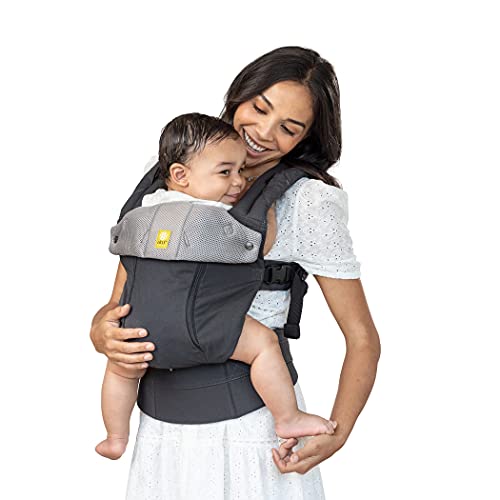
The Complete All Seasons is the six-position entry, the longest list here: front fetal, front infant with a narrow seat, front toddler with a wide seat, front outward, hip, and back. It covers the same 7 to 45 pounds as the Ergobaby and likewise skips the infant insert. LÍLLÉbaby lists the carrier as a hip-healthy product acknowledged by the International Hip Dysplasia Institute.
Its signature feature is the front panel, which zips down to reveal breathable mesh for warm days and zips back up when the air turns cool. The waist extends to 52 inches, the widest fit figure published in this group, and the straps adjust two ways for front or backpack-style wearing. A removable sleeping hood, an extendable back panel, and a zippered storage pocket round out the sheet. The trade-off for all that adjustment is a busier setup, with more settings to learn at the outset.
Specs
- Type: Structured buckle carrier
- Child weight range: 7 to 45 pounds
- Carry positions: 6 (fetal, infant narrow seat, toddler wide seat, outward, hip, back)
- Fabric: Cotton with a zip-down mesh panel
- Infant insert: Not required
- Waist fit: Extends to 52 inches
- Extras: Lumbar support, removable sleeping hood, zippered pocket, extendable back panel
- Care: Machine washable
- Carrier weight: Not stated
- Model: LB-CSA-COAL
Baby Tula Free-to-Grow Cotton Baby Carrier, Discover

The Free-to-Grow takes the opposite approach to the LÍLLÉbaby: two positions, front inward and back, and a short list of adjustments done well. The seat width and the panel height each change settings as the baby grows, which is how it covers 7 to 45 pounds with no infant insert. The body is cotton, the shoulder straps are padded, and a pocket on the waistbelt holds small items.
What you give up is variety. There is no outward-facing position and no hip carry, so a curious baby who wants to watch the room faces you or rides on your back. In exchange, the fit routine is the simplest of the three structured picks: set the seat width for the baby’s size, buckle the waistbelt, and tighten the straps. For parents who know they will carry inward and on the back, that simplicity is the point.
Specs
- Type: Structured buckle carrier
- Child weight range: 7 to 45 pounds
- Carry positions: 2 (front inward, back)
- Fabric: Cotton
- Infant insert: Not required
- Seat: Adjustable width and panel height settings
- Extras: Padded shoulder straps, waistbelt pocket
- Carrier weight: Not stated
- Model: TBCA7BKG1
Boba Baby Wrap Carrier, Grey

The Boba Wrap is the stretchy wrap benchmark: 5.5 yards of French terry fabric, 95 percent cotton and 5 percent spandex, that you wrap and tie around your torso before settling the baby in against your chest. It is rated for 7 to 35 pounds, and the one length is cut to fit wearers from petite to plus sizes, so partners of different builds share it with no hardware to resize.
The stretch is the character of the thing. It gives a close, even hold that suits the newborn weeks, and the fabric distributes weight across your back and shoulders rather than hanging it from two straps. The limits are just as clear: there is one carry position, front inward, and as babies grow heavier the stretch that felt gentle early on lets them sag lower than a woven or structured carrier would. Tying also takes practice before it feels quick.
Specs
- Type: Stretchy wrap
- Child weight range: 7 to 35 pounds
- Carry positions: Front inward
- Fabric: French terry, 95 percent cotton and 5 percent spandex
- Length: 5.5 yards
- Fit: One size, wearer sizes XS to XXL per maker
- Care: Machine washable
- Carrier weight: Not stated
Moby Wrap Classic Baby Carrier, Black
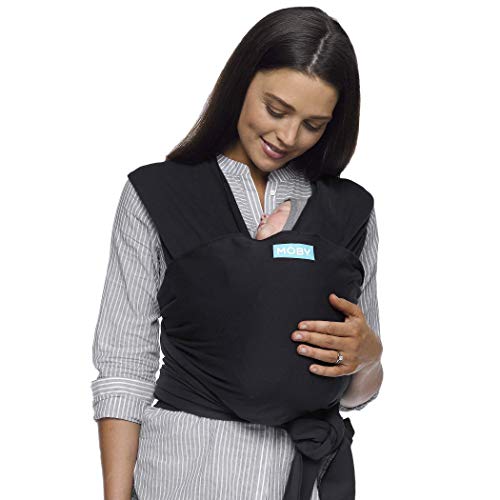
The Moby Wrap Classic is the firmer wrap of the two. It is 100 percent cotton with less give than the Boba’s spandex blend, so the hold feels more secure once tied, and the fabric keeps its shape better as the baby gains weight. The rating runs from 8 to 33 pounds, a slightly narrower window than the Boba at both ends, and the maker lists front inward and hip carries.
Because the cotton has less stretch, tying technique matters more: the wrap needs to be snug before the baby goes in, since it will not spring tighter afterward. In return, many parents find the firmer fabric easier to trust with a heavier infant, and the one-size length adjusts to all body types. Like the Boba, it folds flat into a diaper bag and goes in the wash, and like the Boba it is a front-carry design for the first year rather than a toddler carrier.
Specs
- Type: Stretchy wrap
- Child weight range: 8 to 33 pounds
- Carry positions: Front inward and hip, per maker
- Fabric: 100 percent cotton
- Fit: One size, adjusts to all body types per maker
- Care: Machine washable
- Carrier weight: Not stated
- Model: MCL-BLACK
How to choose
Pick the format first. A wrap gives the closest newborn fit and the smallest packed size, and it asks for tying practice and tops out sooner as the baby gains weight. A structured carrier loads faster, supports a toddler, and adds positions, in exchange for more bulk. Many families end up using a wrap for the first months and a buckle carrier after.
Check the low end of the weight range against your newborn. All five picks begin at 7 or 8 pounds, and none of the structured carriers needs an insert, so a small newborn fits any of them on paper; the maker’s minimum still governs, and a baby under the printed minimum waits. Then check the positions you actually want. Outward facing appears only on the Ergobaby and the LÍLLÉbaby, back carry on all three structured picks, and hip carry on the Ergobaby, the LÍLLÉbaby, and the Moby.
Finally, fit the wearer. Wraps size themselves to whoever ties them. Structured carriers differ in waist reach and strap style: the LÍLLÉbaby waist extends to 52 inches, and crossable straps on the Ergobaby suit narrower shoulders. Warm climates point toward the LÍLLÉbaby’s mesh panel or the lighter wraps; the all-cotton panels hold the most heat.
Who should skip
Skip both wraps if you want a back carry, an outward-facing option, or a carrier that still feels supportive past 35 pounds; all three structured picks cover that ground. Skip the Tula Free-to-Grow if outward facing or hip carry matters to you, since its two positions are front inward and back only. Skip the LÍLLÉbaby if six positions and a zip panel sound like more settings than you will ever use, and skip the Ergobaby Omni Classic in cotton if you carry in serious heat, where its panel is the warmest here.
FAQ
When can a baby face outward in a carrier?
Makers tie outward facing to development rather than age alone: the baby should hold their head and torso steady, and each brand prints its own minimums in its instructions. Of the picks here, only the Ergobaby Omni Classic and the LÍLLÉbaby Complete offer an outward position, and both set the terms in their manuals, so follow the figures for the carrier you own.
Do I need an infant insert for a newborn?
Not with any pick in this roundup. The three structured carriers are each rated from 7 pounds with adjustable seats, so the insert era has passed for these models, and the two wraps cradle a newborn directly in the fabric. An insert only enters the picture with older carrier designs built around a higher minimum weight.
Can two adults of different sizes share one carrier?
Yes, and the wraps make it easiest, since the fabric ties to fit whoever wears it and the Boba is cut for wearer sizes from XS to XXL. Structured carriers share well too: the waistbelt and straps readjust in a minute, and the LÍLLÉbaby waist reaches 52 inches, the widest published fit here. Crossable straps, as on the Ergobaby, help the carrier sit well on narrower shoulders.
How should a newborn sit in a wrap or carrier?
Follow the positioning guidance every maker prints: baby upright and close enough to kiss, face visible and uncovered, chin off the chest, and legs in a spread seat with knees above the bottom. Recheck the fit each time you tie or buckle, since fabric and straps settle as you move. A baby who slumps or whose face presses into fabric or your body needs to be repositioned right away.
Final verdict
The Ergobaby Omni Classic is the best all-around structured pick, with four positions, a 7 to 45 pound range, and lumbar support in a cotton panel. The LÍLLÉbaby Complete All Seasons is the choice for maximum positions and warm-weather airflow, and the Tula Free-to-Grow is the simpler buckle carrier for front and back carrying. For the newborn months, the Boba Wrap gives the stretchiest close fit, while the Moby Wrap Classic trades some give for a firmer hold.
Product and ASIN Reference
| Product | ASIN |
|---|---|
| Ergobaby Omni Classic Baby Carrier, Pure Black | B0743KZY9C |
| LÍLLÉbaby Complete All Seasons Baby Carrier, Charcoal and Silver | B08PPZ52C9 |
| Baby Tula Free-to-Grow Cotton Baby Carrier, Discover | B06XK45QHW |
| Boba Baby Wrap Carrier, Grey | B005SP2LWW |
| Moby Wrap Classic Baby Carrier, Black | B000OY539A |
FAQ
When can a baby face outward in a carrier?
Do I need an infant insert for a newborn?
Can two adults of different sizes share one carrier?
How should a newborn sit in a wrap or carrier?
More from Amazon
Programs that pair well with the guide above. Offers and eligibility are set by Amazon and may change.
Free shipping on eligible items, Prime Video and more. Eligible new members can start with a free trial.
Start a Prime free trialAudiobooks and podcasts to listen to on the go. Eligible new members can start with a free trial.
Try Audible freeAd-free music streaming. Eligible new subscribers can start with a free trial.
Try Music Unlimited freeA free business account with business pricing and bulk-buying tools for work, shop or home office.
Create a business accountAs an Amazon Associate we earn from qualifying purchases.


Write Your Review
No reviews yet. Be the first to share your experience!